'%20role='img'%20aria-label='Digital%20Dust%20Library'%3e%3cpath%20d='M%2094%2040%20V%2080%20A%2014%2014%200%200%201%2080%2094%20H%2020%20A%2014%2014%200%200%201%206%2080%20V%2020%20A%2014%2014%200%200%201%2020%206%20H%2060'%20stroke='currentColor'%20stroke-width='5'%20stroke-linecap='round'%20stroke-linejoin='round'%3e%3c/path%3e%3crect%20x='22'%20y='32'%20width='13'%20height='46'%20rx='4'%20stroke='currentColor'%20stroke-width='5'%20stroke-linejoin='round'%3e%3c/rect%3e%3crect%20x='38'%20y='40'%20width='13'%20height='38'%20rx='4'%20stroke='currentColor'%20stroke-width='5'%20stroke-linejoin='round'%3e%3c/rect%3e%3crect%20x='54'%20y='50'%20width='12'%20height='28'%20rx='4'%20stroke='currentColor'%20stroke-width='5'%20stroke-linejoin='round'%3e%3c/rect%3e%3cpath%20d='M25%2070%20H32%20M41%2070%20H48%20M57%2070%20H63'%20stroke='currentColor'%20stroke-width='4'%20stroke-linecap='round'%3e%3c/path%3e%3crect%20x='59'%20y='40'%20width='6'%20height='6'%20rx='1.2'%20stroke='currentColor'%20stroke-width='2.4'%3e%3c/rect%3e%3crect%20x='66'%20y='42'%20width='5'%20height='5'%20rx='1'%20fill='currentColor'%3e%3c/rect%3e%3crect%20x='64'%20y='31'%20width='5'%20height='5'%20rx='1'%20stroke='currentColor'%20stroke-width='2.2'%3e%3c/rect%3e%3crect%20x='73'%20y='35'%20width='5'%20height='5'%20rx='1'%20fill='currentColor'%3e%3c/rect%3e%3crect%20x='70'%20y='25'%20width='4'%20height='4'%20rx='1'%20stroke='currentColor'%20stroke-width='2'%3e%3c/rect%3e%3crect%20x='79'%20y='29'%20width='4'%20height='4'%20rx='1'%20fill='currentColor'%3e%3c/rect%3e%3crect%20x='76'%20y='19'%20width='4'%20height='4'%20rx='1'%20stroke='currentColor'%20stroke-width='2'%3e%3c/rect%3e%3crect%20x='85'%20y='23'%20width='3.4'%20height='3.4'%20rx='0.9'%20fill='currentColor'%3e%3c/rect%3e%3crect%20x='82'%20y='14'%20width='3.4'%20height='3.4'%20rx='0.9'%20stroke='currentColor'%20stroke-width='1.8'%3e%3c/rect%3e%3crect%20x='89'%20y='17'%20width='3'%20height='3'%20rx='0.8'%20fill='currentColor'%3e%3c/rect%3e%3crect%20x='74'%20y='12'%20width='3'%20height='3'%20rx='0.8'%20fill='currentColor'%3e%3c/rect%3e%3crect%20x='90'%20y='10'%20width='2.4'%20height='2.4'%20rx='0.7'%20stroke='currentColor'%20stroke-width='1.6'%3e%3c/rect%3e%3crect%20x='80'%20y='8'%20width='2.4'%20height='2.4'%20rx='0.7'%20fill='currentColor'%3e%3c/rect%3e%3c/svg%3e)

Framing
Ask ten people what "early retirement" means and you get ten different answers, but most of those answers hide the same mix-up. Two unrelated things get called by the same name.
The first is a number a government sets by law: the age at which the state starts paying a pension. This age is fixed by legislation, differs sharply by country, and has almost nothing to do with any individual's own savings. The second is a personal decision: someone builds enough investments to stop working on their own money, often years or decades before any government pension applies. This second version is what most people mean by "early retirement" today, usually under the name FIRE (Financial Independence, Retire Early) a movement built around reaching financial independence fast enough to leave paid work far ahead of the standard retirement age.
Two rulebooks, not one. A government changes its statutory retirement age by passing a law; a person pursuing self-funded early retirement answers to compound interest and market returns instead. Confusing the two leads to bad conclusions for instance, assuming that a country with a high statutory retirement age makes early retirement there impossible, when in practice a self-funded exit can happen decades before any state pension becomes relevant at all.
This article treats both versions on their own terms: where each one came from, how they work in three specific countries, the actual math behind self-funded early retirement, and what leaving work early does to a person's health and mind.
A Short History of Not Working Anymore
For most of human history, "retirement" as a distinct life stage did not exist. People worked as long as their bodies allowed, then depended on family or community support when they could not. There was no fixed age, no pension, and no separate word for it.
The first government old-age insurance program appeared in Germany in 1889, created under Chancellor Otto von Bismarck [Deutschlandmuseum]. A popular story claims the pension age of 65 was chosen to match Bismarck's own age, or picked so that most workers would die before collecting. Both claims are false a myth stubborn enough to still turn up in retirement-planning blogs a century later. Germany's original pension age in 1889 was 70, not 65 and Bismarck was 74 years old at the time. The age was only lowered to 65 in 1916, eighteen years after Bismarck's death [SSA: Otto von Bismarck].
The United States adopted age 65 in the Social Security Act of 1935, but not for symbolic reasons. About half of the thirty US state pension systems already in place at the time used age 65; the other half used 70. The Railroad Retirement System, set up the year before, had also chosen 65. Calculations based on how long people were expected to live showed that age 65 would let the new system pay for itself without heavy taxes [SSA: Why 65].
One more myth is worth clearing up here: the idea that Social Security was designed so most people would die before ever collecting a pension. Life expectancy at birth in the 1930s was around 58 years for men and 62 for women, which looks low enough to support that theory. But this number mostly reflects high rates of infant and child death, not adult mortality. A man who actually reached age 65 could expect about 12.7 more years of life; a woman, about 14.7 more. By 1935, 7.8 million Americans were already 65 or older [SSA: Life Expectancy]. The system was built around realistic numbers for people who reached old age, not a bet that they would not.
That is the history of retirement as a state-run program. Self-funded early retirement has a separate, much shorter one. Its modern starting point is Your Money or Your Life (1992) by Vicki Robin and Joe Dominguez, which reframed spending as hours of life traded for money and proposed tracking that trade deliberately to reach financial independence. Jacob Lund Fisker's Early Retirement Extreme (2010) turned the idea into explicit math linking a person's savings rate to the number of years needed to become financially independent. Peter Adeney's blog Mr. Money Mustache, started in 2011, popularized extreme frugality as the fastest route out of paid work and reached a large online audience. Grant Sabatier's Financial Freedom (2019) added a different angle: earning aggressively more, instead of spending less, to shorten the same timeline [Wikipedia: FIRE movement]. Together, these works built what is now called the FIRE movement Financial Independence, Retire Early.
Two histories, then: one a government program born from industrial-era welfare policy, the other a personal-finance idea born from resistance to standard career and spending patterns. Both get called "early retirement." The rest of this article treats them separately before bringing them back together.
Three Countries, Three Rulebooks
Statutory retirement age the age at which a government allows someone to start collecting a state pension — varies enormously worldwide. Current figures put the global range at roughly 47 years in Saudi Arabia to 70 years in Libya, with most of Europe sitting between 62 and 67 [Visual Capitalist; World Population Review]. Three countries show how differently this number gets built in practice.
United States. Full retirement age under Social Security the age at which someone receives their entire calculated benefit, with no reduction is 67 for anyone born in 1960 or later. Workers can start collecting earlier, at 62, but the trade-off is steep and permanent: someone born in 1960 or later who claims at 62 receives 30% less every month, for the rest of their life, compared to waiting until 67. A benefit that would be $1,000 a month at full retirement age becomes a fixed $700 a month if claimed four years early [SSA: agereduction]. The penalty exists specifically to keep the system's total payout roughly balanced regardless of when someone starts collecting.
France. A 2023 reform raised the statutory age from 62 to 64, phased in gradually for people born between 1961 and 1968, with the change fully in effect by 2032. The age for a full, unreduced pension regardless of career length stays at 67. France does allow earlier exits for long careers: someone who began working at 16 can retire at 58; at 18, at 60; and a new option lets people who started at 21 retire at 63. Each path requires a minimum number of contribution quarters, not age alone [CLEISS].
Armenia. The statutory age is 63 for anyone with qualifying work experience, or 65 without it, and it applies equally to men and women a figure that has not moved in years, with no announced plans to raise it [TradingEconomics]. A minimum of 10 years of contributions is required. Narrow early-exit paths exist mainly for hazardous or physically demanding work: age 55 after 25 years of total experience including at least 15 in hard-labor conditions, or age 59 after 25 years with at least 20 in hard labor [Repat Armenia]. The average monthly pension is around 50,000 AMD modest enough that, for most people, the Armenian state pension functions as a floor rather than something to plan an early exit around. The pension age itself is unremarkable. What matters is the cost of living which the next section puts to use.
Three systems, three logics: the US penalizes early claiming with a fixed formula, France ties early exit to how young someone started working, and Armenia's system barely engages with "early" at all outside hazardous professions leaving self-funded retirement as the only real lever for most people there.
The Math: How Much, and When
Self-funded early retirement runs on one central calculation: the 4% rule, also called the 25x rule. It comes from the Trinity Study (1998), a paper by three professors at Trinity University who tested withdrawal rates from 3% to 12% against historical US market data, across portfolios with different mixes of stocks and bonds, to see which rates let a portfolio survive 30 years of withdrawals without running out [The Poor Swiss: Updated Trinity Study]. Their headline result: withdrawing 4% of a portfolio's starting value each year, adjusted for inflation, succeeded in the vast majority of historical 30-year periods for a stock-heavy portfolio. Flipped around, this means someone needs a portfolio worth 25 times their annual expenses before their investment income alone can cover their spending indefinitely. Spend $40,000 a year, and the target is $1,000,000.
The 30-year assumption is the catch for early retirees. Someone who stops working at 35 or 45 may need their money to last 50 years, not 30. A 2025 update to the Trinity Study, using data through 2025 and testing retirement lengths up to 50 years, found that a 3.5% withdrawal rate meaning a target closer to 28.6 times annual expenses succeeds more than 98% of the time over a 50-year horizon with a stock-heavy portfolio [The Poor Swiss: Updated Trinity Study]. The extra years of retirement cost roughly 3–4 additional years of savings at the target.
This single number gets applied differently depending on how someone defines "enough." The FIRE community splits it into variants: LeanFIRE targets a minimal budget and therefore a smaller portfolio; FatFIRE keeps a comfortable, higher-spending lifestyle and needs a much larger one; CoastFIRE means saving aggressively early, then stopping additional contributions once compound growth alone will reach the target by a normal retirement age, while still working to cover current costs; BaristaFIRE means reaching a partial number and covering the rest with part-time or lower-stress work instead of quitting entirely [Wikipedia: FIRE movement]. All four use the same 4%-style math they just plug in a different annual expense number.
When someone reaches that number depends on only one variable: savings rate, the share of take-home income put toward investments rather than spending. A higher savings rate does two things at once it shrinks the target (since expenses, and therefore 25x expenses, go down) and speeds up how fast savings accumulate. The relationship is sharply non-linear, not a straight line:
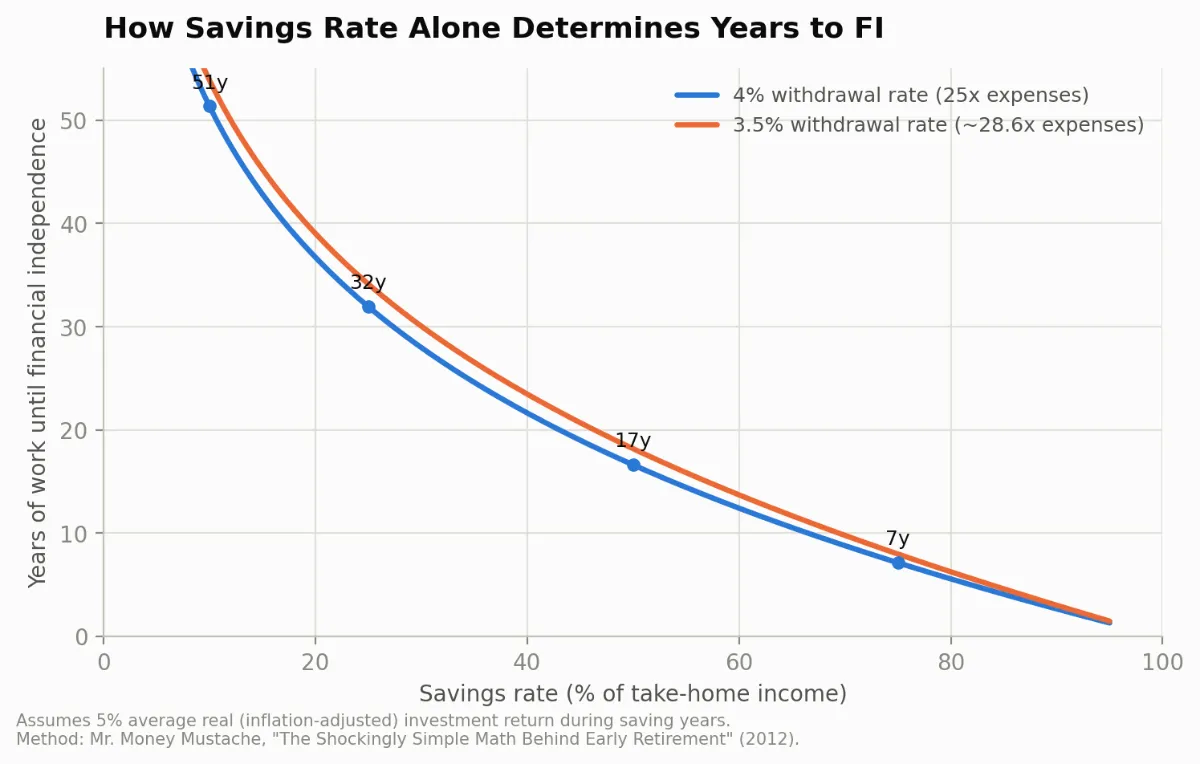
At a 10% savings rate typical for many standard retirement-savings advice columns reaching independence takes around 51 years, assuming a 5% average real (inflation-adjusted) investment return during the saving years. At 25%, it drops to 32 years. At 50%, it drops to 17 years. At 75%, seven years [Mr. Money Mustache: The Shockingly Simple Math Behind Early Retirement]. This is the actual engine behind FIRE: not exceptional investment returns, but an exceptional savings rate.
The target number itself, though, depends heavily on where someone lives which is where the three countries from the previous section matter again. Using $40,000 a year as a reference lifestyle in the United States, and rescaling it by relative cost of living [Numbeo: Cost of Living Comparisons, 2025–2026 data], the chart below shows both figures for each country: the annual cost of living that lifestyle actually translates to, and the 25x portfolio target that cost produces.
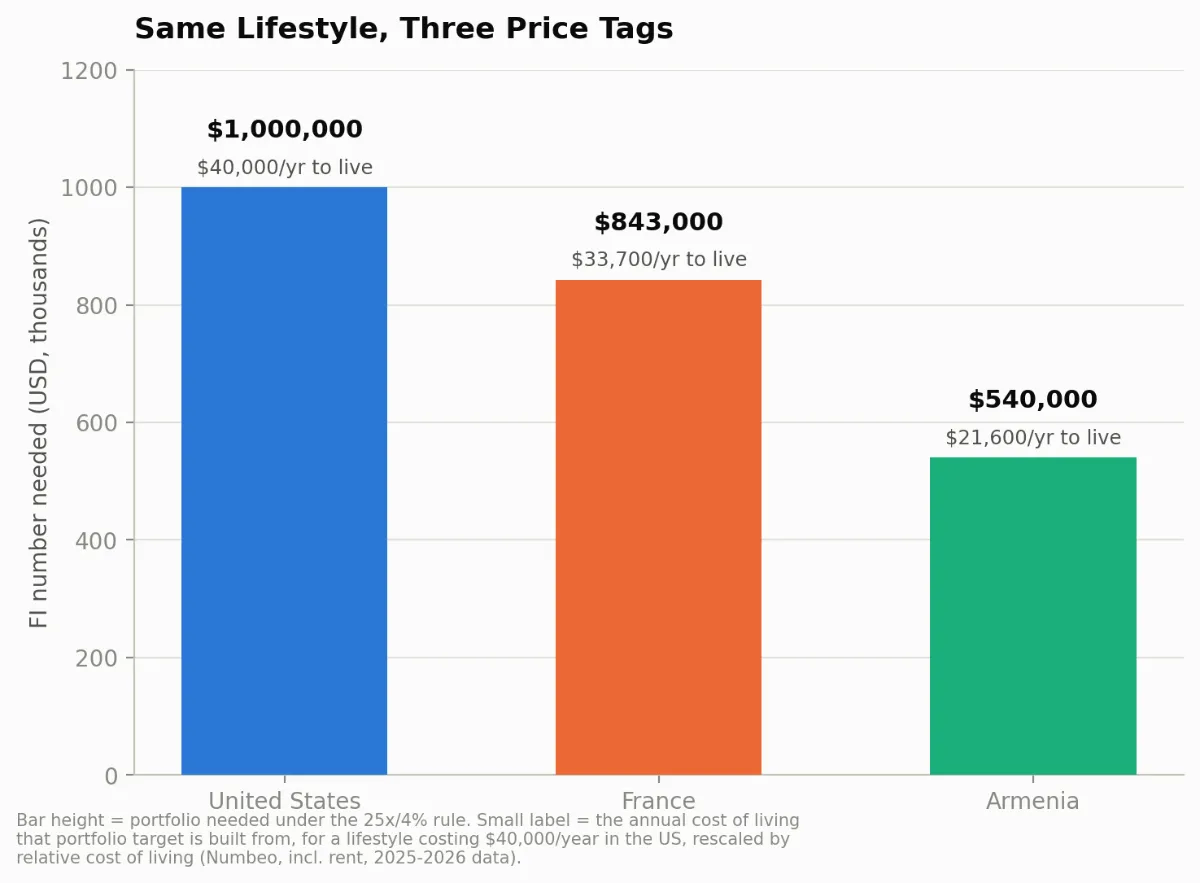
A little over half as much money buys the same lifestyle in Armenia as it does in the United States $21,600 a year against $40,000, and a $540,000 target against $1,000,000. At any fixed savings rate and income, that difference alone can cut years off the timeline a separate lever from the savings-rate curve above, and one that has nothing to do with any country's statutory retirement age.
Social and Psychological Aspects
Whether leaving work early helps or hurts a person depends less on the age itself than on how and why they leave. A 2025 study followed roughly 5,900 Swedish adults aged 60 to 74 over nine years, tracking their mental health, physical health, and cognitive performance around the time they retired [European Journal of Ageing, 2025]. People who retired around age 61 showed clear improvements: higher life satisfaction, better quality of life, better memory test scores, fewer depressive symptoms, and a lower overall disease burden. People who kept working until 69 showed little change in these same measures, and in some cases a small decline.
Two factors shaped the result more than age itself did. The first is job satisfaction before retirement. Workers who disliked their jobs improved after leaving, regardless of when they left. Workers who liked their jobs saw smaller benefits from retiring, and this effect grew stronger the later they retired meaning a satisfied worker kept working past their preferred age got little psychological payoff from finally stopping. The second is whether the retirement was voluntary (the person's own choice) or involuntary (forced by health, layoffs, or other circumstances outside their control). Involuntary transitions hurt in both directions: forced early retirement and forced late retirement both reduced the health benefits, and being pushed out later than wanted specifically raised depressive symptoms and lowered quality of life.
Mental health responded most strongly to these patterns. Physical and cognitive health moved less, and one detail stands out: reasoning ability actually declined slightly among the group that kept working until 69 the opposite of what a "staying mentally active by working longer" argument would predict.
One limitation is worth stating directly rather than glossing over: this study's participants were all in their 60s and 70s. It says something real about typical retirement timing, but it does not directly describe someone who leaves paid work at 35 or 45 through the FIRE route decades earlier, and usually for different reasons than a standard-age retiree. Whether the same voluntary-versus-forced, satisfaction-dependent pattern holds for a 40-year-old leaving a well-paid career is an open question this research does not answer. That gap matters for anyone using this section to judge their own plan against research built on a very different group of retirees.
Pros and Cons of Early Retirement
The case for it. The clearest gain, from the psychological research above, is health and life satisfaction but only under specific conditions: retirement is voluntary, and the job being left was not a good fit. Under those conditions, mental health, memory scores, and disease burden all moved in a favorable direction in the Swedish data. Beyond health, early retirement returns the largest fixed resource anyone has time years earlier than a standard career timeline allows, for activities, relationships, or work that a paycheck was not funding.
The case against it — four separate costs.
Healthcare, in countries without universal coverage. In the United States specifically, someone who retires before 65 loses employer-sponsored insurance and must buy it individually until Medicare, the public health program, begins. Average premiums for a standard plan in this age range run about $1,100–$1,170 a month, or roughly $13,000–$14,000 a year per person, before deductibles, copayments, and prescription costs are added on top [SmartAsset: Health Insurance Age 62–65]. France and Armenia, with universal or near-universal public healthcare, do not carry this specific cost one of the few times a public healthcare system comes out ahead of the US in a personal-finance spreadsheet.
Permanent benefit reductions. Claiming a state pension early, where that option exists at all, locks in a smaller payment for life. The US Social Security example above a 30% permanent cut for claiming at 62 instead of 67 is not unusual; France's long-career exceptions carry their own reduced-benefit trade-offs for leaving earlier.
A longer, riskier withdrawal period. The earlier shift from a 4% to a 3.5% safe withdrawal rate for 40–50-year retirements is not a rounding error it means roughly 3–4 extra years of saving are needed at the same spending level, purely because the money has to last longer and absorb more decades of market volatility.
Loss of identity and social network. Self-definition through a profession is a stronger effect for men, and its loss is tied to a measurable decline in wellbeing: one study found that shrinking social network size accounted for 79.5% of the drop in retirees reporting good physical health, driven mainly by the loss of wider workplace connections rather than family relationships [International Journal of Caring Sciences: Galanis et al.]. How someone spends the reclaimed time matters directly replacing work hours with physical activity and sleep improved mental health outcomes in the same research, while replacing them with screen time did not.
None of these four costs is automatic a country with public healthcare removes the first, a person who never valued their professional identity may barely notice the fourth but all four are structural enough that they belong in the decision alongside the appeal of simply not working anymore.
Counterpoints and Open Questions
FIRE's popularity online exceeds its actual reach. A 2018 Harris Poll found that only 11% of wealthier Americans aged 45 and older had heard of the movement by name, with another 26% aware of the underlying concept without knowing the label [Wikipedia: FIRE movement]. That leaves a majority of even a relatively affluent, retirement-age-adjacent population unfamiliar with it entirely. Loud online community, small real footprint worth remembering before treating FIRE as how most people, even wealthy ones, actually think about retirement.
The demographic that does pursue it skews narrow for structural reasons, not just awareness: the savings-rate math above rewards a high savings rate, which itself requires an income well above basic living costs. Early adopters were concentrated in high-earning fields like software engineering professions that make a 50%+ savings rate mathematically possible in a way that lower-wage work does not.
There is also a policy-level tension sitting underneath the whole subject. While a subculture pursues self-funded retirement decades early, the governments covered above are moving the other direction. The OECD has stated that population aging, driven by lower birth rates and longer life expectancies, will keep raising fiscal pressure on pension systems at a time of already high public debt [OECD, November 2025]. Statutory retirement ages, where they move at all, tend to move up rather than down France's 2023 reform being one direct example. The two trends run in opposite directions without directly touching: individuals racing toward early exits fund themselves privately, mostly outside the state system, while the state system itself faces pressure to delay the age at which it pays out. Neither trend currently resolves the other.
Takeaway
"Early retirement" turns out to be at least three separate questions wearing one name, and this article has treated them as three because they don't share a rulebook.
The first is a legal question: at what age does a government start paying a pension? The answer ranges from roughly 47 to 70 worldwide, and the three countries examined here show three different logics behind that number the US penalizes early claiming with a fixed permanent cut, France ties early exit to how young someone started working, and Armenia barely engages with "early" outside hazardous professions, leaving self-funded retirement as the only real option for most people there. The second is a math question: how much money, saved at what rate, replaces an income indefinitely? Here the answer depends on two independent levers — savings rate, which can compress a multi-decade timeline into one or two, and cost of living, which can cut the target dollar amount by nearly half depending on where someone lives. The third is a psychological question: does leaving work early actually make a person better off? The honest answer from the research is "sometimes" specifically when the exit is voluntary and the job being left wasn't a good fit, and not reliably otherwise.
None of these three questions answers the other two. A government's statutory pension age says nothing about whether someone's personal FIRE math works. A savings-rate calculation says nothing about whether the resulting decades without a job will feel good. And the psychological research, built on people retiring in their 60s, doesn't cleanly apply to someone leaving a career at 35.
The practical implication is simple to state, even though the underlying material isn't: before asking "when can I retire early," it's worth being specific about which of the three questions is actually being asked the legal one, the financial one, or the psychological one because the answer to each lives in a different place, and confusing them is exactly the mix-up this article opened with.
References
History
The Origin of Statutory Retirement Insurance — Deutschlandmuseum — https://www.deutschlandmuseum.de/en/history/calendar/1889-05-24-the-origin-of-statutory-retirement-insurance/
Social Security History: Otto von Bismarck — US Social Security Administration — https://www.ssa.gov/history/ottob.html
Social Security History: Why 65? — US Social Security Administration — https://www.ssa.gov/history/age65.html
Social Security History: Life Expectancy — US Social Security Administration — https://www.ssa.gov/history/lifeexpect.html
FIRE movement — Wikipedia — https://en.wikipedia.org/wiki/FIRE_movement
Country retirement systems
Charted: Retirement Age by Country Visual Capitalist https://www.visualcapitalist.com/retirement-age-by-country/
Retirement Age by Country 2026 World Population Review https://worldpopulationreview.com/country-rankings/retirement-age-by-country
Benefits Planner: Retirement Effect of Early or Delayed Retirement on Benefits US Social Security Administration https://www.ssa.gov/benefits/retirement/planner/agereduction.html
Raising the Statutory Retirement Age to 64 in France CLEISS (French liaison body for social security) https://www.cleiss.fr/actu/2023/2305-raising-statutory-retirement-age-to-64-france.html
Armenia Retirement Age – Men Trading Economics https://tradingeconomics.com/armenia/retirement-age-men
Retirement System in Armenia Repat Armenia https://www.repatarmenia.org/repatriate/practical-information/retirement/retirement-system-in-armenia
The math
Updated Trinity Study for 2026 More Withdrawal Rates! The Poor Swiss https://thepoorswiss.com/updated-trinity-study/
The Shockingly Simple Math Behind Early Retirement Mr. Money Mustache (2012) https://www.mrmoneymustache.com/2012/01/13/the-shockingly-simple-math-behind-early-retirement/
Cost of Living Comparison, United States vs. Armenia Numbeo https://www.numbeo.com/cost-of-living/compare_countries_result.jsp?country1=United+States&country2=Armenia
Cost of Living Comparison, France vs. United States Numbeo https://www.numbeo.com/cost-of-living/compare_countries_result.jsp?country1=France&country2=United+States
Social and psychological effects
Retirement as risk or relief? The role of timing in mental, physical and cognitive health effects of retirement European Journal of Ageing (2025), via PMC https://pmc.ncbi.nlm.nih.gov/articles/PMC12779816/
Psychosocial Effects of Retirement on the Elderly (Galanis et al.) International Journal of Caring Sciences https://www.internationaljournalofcaringsciences.org/docs/12.-galanis.pdf
Health Insurance Age 62 to 65: Average Cost Before Medicare SmartAsset https://smartasset.com/insurance/health-insurance-age-62-to-65-average-cost
Policy context
Rapidly Ageing Populations Will Continue to Put Pressure on Pension Systems OECD (November 2025) https://www.oecd.org/en/about/news/press-releases/2025/11/rapidly-ageing-populations-will-continue-to-put-pressure-on-pension-systems.html