'%20role='img'%20aria-label='Digital%20Dust%20Library'%3e%3cpath%20d='M%2094%2040%20V%2080%20A%2014%2014%200%200%201%2080%2094%20H%2020%20A%2014%2014%200%200%201%206%2080%20V%2020%20A%2014%2014%200%200%201%2020%206%20H%2060'%20stroke='currentColor'%20stroke-width='5'%20stroke-linecap='round'%20stroke-linejoin='round'%3e%3c/path%3e%3crect%20x='22'%20y='32'%20width='13'%20height='46'%20rx='4'%20stroke='currentColor'%20stroke-width='5'%20stroke-linejoin='round'%3e%3c/rect%3e%3crect%20x='38'%20y='40'%20width='13'%20height='38'%20rx='4'%20stroke='currentColor'%20stroke-width='5'%20stroke-linejoin='round'%3e%3c/rect%3e%3crect%20x='54'%20y='50'%20width='12'%20height='28'%20rx='4'%20stroke='currentColor'%20stroke-width='5'%20stroke-linejoin='round'%3e%3c/rect%3e%3cpath%20d='M25%2070%20H32%20M41%2070%20H48%20M57%2070%20H63'%20stroke='currentColor'%20stroke-width='4'%20stroke-linecap='round'%3e%3c/path%3e%3crect%20x='59'%20y='40'%20width='6'%20height='6'%20rx='1.2'%20stroke='currentColor'%20stroke-width='2.4'%3e%3c/rect%3e%3crect%20x='66'%20y='42'%20width='5'%20height='5'%20rx='1'%20fill='currentColor'%3e%3c/rect%3e%3crect%20x='64'%20y='31'%20width='5'%20height='5'%20rx='1'%20stroke='currentColor'%20stroke-width='2.2'%3e%3c/rect%3e%3crect%20x='73'%20y='35'%20width='5'%20height='5'%20rx='1'%20fill='currentColor'%3e%3c/rect%3e%3crect%20x='70'%20y='25'%20width='4'%20height='4'%20rx='1'%20stroke='currentColor'%20stroke-width='2'%3e%3c/rect%3e%3crect%20x='79'%20y='29'%20width='4'%20height='4'%20rx='1'%20fill='currentColor'%3e%3c/rect%3e%3crect%20x='76'%20y='19'%20width='4'%20height='4'%20rx='1'%20stroke='currentColor'%20stroke-width='2'%3e%3c/rect%3e%3crect%20x='85'%20y='23'%20width='3.4'%20height='3.4'%20rx='0.9'%20fill='currentColor'%3e%3c/rect%3e%3crect%20x='82'%20y='14'%20width='3.4'%20height='3.4'%20rx='0.9'%20stroke='currentColor'%20stroke-width='1.8'%3e%3c/rect%3e%3crect%20x='89'%20y='17'%20width='3'%20height='3'%20rx='0.8'%20fill='currentColor'%3e%3c/rect%3e%3crect%20x='74'%20y='12'%20width='3'%20height='3'%20rx='0.8'%20fill='currentColor'%3e%3c/rect%3e%3crect%20x='90'%20y='10'%20width='2.4'%20height='2.4'%20rx='0.7'%20stroke='currentColor'%20stroke-width='1.6'%3e%3c/rect%3e%3crect%20x='80'%20y='8'%20width='2.4'%20height='2.4'%20rx='0.7'%20fill='currentColor'%3e%3c/rect%3e%3c/svg%3e)
From Tools to a Portfolio
In Parts 1 to 3 we learned the tools: stocks, bonds, deposits, index funds, ETFs, brokers, and the rules that differ by country. A pile of tools is not a plan. A portfolio is everything you invest in, seen as one whole. In this article we build one step by step, and we use plain words for every new term.
Be warned: there is no perfect portfolio. The best one is the one that fits your goal, your time, and your nerves, and that you can keep for years without panic. What we can do is show a clear way of thinking, and then show examples, including a full example portfolio.
Quick dictionary
WordMeaning in plain EnglishPortfolioAll your investments, seen together.Asset allocationHow you divide your money between stocks, bonds, and cash.Emergency fundSafe, easy-to-reach money for unexpected costs.Time horizonHow long you plan to invest before you need the money.Risk toleranceHow much loss you can accept, in ability and in feeling.RebalancingBringing your mix back to your plan after prices moved it.DriftHow far your mix has moved away from your plan.Glide pathA schedule that moves a portfolio from stocks toward bonds as you age.Dollar-cost averagingInvesting a fixed amount at regular intervals.BucketOne group of investments with one job and one target percentage.
Before You Invest: Build the Base
Investing comes second. First you need money that you can reach in a bad week, so you never have to sell your investments at a bad moment. This is the emergency fund.
How much? The US consumer protection agency gives no magic number. It says the amount depends on your situation, and suggests you think about the most common unexpected expenses you have had in the past and what they cost. It also says that even a small amount can give you some financial security [CFPB]. Where to keep it? The same guide says the money should be safe and accessible, and calls a bank or credit union account "generally considered one of the safest places to put your money". It also suggests automatic transfers on a schedule, so saving does not depend on your mood [CFPB].
From Part 3, you already know how this works: a deposit is protected by a guarantee up to a limit that your country sets, and it will not beat inflation by much. That is fine. The job of this money is to be there, not to grow.
Three Questions That Shape Every Portfolio
Before choosing any fund, answer these three questions. Investor.gov, the US regulator's education site, puts it this way:
1) What is your time horizon? It is "the number of months, years, or decades you plan to invest to achieve your financial goal". Longer horizons can accept more ups and downs. Shorter horizons usually prefer calmer investments [Investor.gov].
2) What is your risk tolerance? It is "your ability and willingness to lose some or all of your original investment" in exchange for a chance of higher returns. Notice the two words: ability (can you afford a loss?) and willingness (can you sleep with it?). The regulator also warns that online risk questionnaires may favour the products of the sites that run them [Investor.gov].
3) What is the goal? A house in five years, a business in ten, a calm retirement in thirty: each one needs a different mix, and sometimes a different portfolio.
Asset Allocation and Diversification
Asset allocation means "dividing your investments among different assets, such as stocks, bonds, and cash". The right mix is personal, and it changes during your life [Investor.gov]. Diversification is the second layer: spreading your money across different investments and, inside each type, across different companies and sectors. The classic phrase is "Don't put all your eggs in one basket". One warning from the regulator is useful in Part 2 terms: a narrowly focused fund may not diversify you much, so check its top holdings [Investor.gov].
What does history say about mixes? In the long UBS data, a portfolio of 60% stocks and 40% bonds never lost more than 50% in real terms, while stocks alone and bonds alone each lost more than 70% more than once [UBS]. But a mix is not magic. In 2022, a 60/40 portfolio of US stocks and 10-year US Treasury bonds fell 17.5%, its worst year since 1937, because stocks and bonds fell together [Morgan Stanley IM]. Use these numbers to understand the range of what can happen. Do not read them as a promise.
The Ready-Made Option: Target Date Funds
If you do not want to build a mix yourself, there is a product that does it for you: the target date fund. It holds a mix of investments, such as stocks and bonds, and changes the mix over time. The year in its name is usually the year you expect to retire or reach another goal. The schedule that moves the fund from stocks toward bonds is called the glide path [SEC, Target Date Funds].
The SEC bulletin (March 2025) lists what to check:
1) "To" or "through". A "to" glide path becomes more conservative until the target date and then stops. A "through" glide path keeps shifting after it [SEC, Target Date Funds].
2) Same year, different fund. Funds with the same target date can use different strategies and risk levels, so their returns can differ widely [SEC, Target Date Funds].
3) Two layers of fees. Costs can come from the target date fund and from the funds inside it. The bulletin repeats that "even small differences in fees can translate into large differences in returns over time" [SEC, Target Date Funds].
4) No guarantee. These funds do not guarantee that you will have enough income at or after the target date [SEC, Target Date Funds].
To see what a real glide path looks like, here are three published points from Vanguard's research (May 2025): 90% in stocks at age 25, 50% at retirement at age 65, and 30% at about age 72 [Vanguard]. We use these points as a reference later in this article.
How to Invest Over Time
Once you have a mix, you must decide how to put money in. You have two basic ways. You can invest the whole amount at once, a lump sum, or you can invest fixed amounts at regular intervals, which is dollar-cost averaging [FINRA]. In Part 1 we saw Vanguard's study of 1976 to 2022: the lump sum beat spreading the money about 68% of the time, but spreading it can help people who fear seeing a loss, and it beat staying in cash [Vanguard].
Most people do not have a lump sum anyway. They have a salary. For them, regular investing happens by itself, and the hardest part is to keep doing it when the news is scary. Automate it if your broker allows it, so the decision is made once, calmly.
Rebalancing: Keeping the Mix Honest
Prices move, and your mix moves with them. The regulator gives a clear example: you start with 60% in stocks, a good year pushes it to 80%, and now you hold more risk than you planned. To bring the portfolio "back to its original asset allocation", you rebalance: sell some of what grew, and add to what lagged. The regulator also notes that this "forces you to buy low and sell high" [Investor.gov].
How often? Some experts check on a fixed schedule, such as every six or 12 months. Others rebalance when a part of the mix drifts past a set limit. In both cases, "rebalancing tends to work best when done relatively infrequently" [Investor.gov]. A target date fund does this for you [Investor.gov].
There is also a gentle way to rebalance: use new money. When you invest each month, put it into the part of the portfolio that is below target, and you may not need to sell anything. Selling can have costs and, in some countries, taxes, so check yours.
Chart 4 later in the article shows a hypothetical example of drift and the trades that fix it.
The Mistakes That Cost the Most
A good plan fails mostly because of human behaviour, not because of bad math. A US SEC bulletin lists nine patterns that can hurt returns [SEC, Behavioral Patterns]. It is from 2014 and about US investors, but you will recognise yourself:
1) Active trading: frequent buying and selling to chase gains.
2) The disposition effect: holding losing investments too long and selling winners too soon.
3) Ignoring fees: choosing funds by past returns and overlooking expense ratios and trading costs.
4) Familiarity bias: favouring investments from your own country, region, or company.
5) Manias and panics: a rapid rise driven by excitement, then a sharp fall.
6) Momentum investing: betting that a trend will simply continue.
7) Naive diversification: spreading money equally across all options, whatever their risk.
8) Noise trading: trading without real information, often with poor timing.
9) Inadequate diversification: too much money in one type of investment.
Market timing deserves its own warning. FINRA notes that "buy low and sell high" is easier said than done, that trading often brings higher costs, and that some of the best trading days happen in volatile periods. Selling in a sharp drop that turns out to be temporary can mean missing the recovery [FINRA].
How much does behaviour cost? Experts disagree. Morningstar's 2025 "Mind the Gap" study found that investors earned about 7.0% a year, against 8.2% for the funds they held, over the 10 years to the end of 2024, a gap of about 1.2 points a year [Morningstar via WealthManagement.com]. Researchers in the Financial Analysts Journal reviewed the same data and put the timing cost at only about 0.10% a year [CFA Institute]. The size of the gap is debated. The advice is the same: a plan you decided calmly beats a decision you make during a panic.
Scams: The Red Flags
A portfolio can also be destroyed by someone who never touches the market: a fraudster. The SEC's checklist of red flags includes [Investor.gov, Red Flags]:
1) Unlicensed investment professionals.
2) Aggressive sellers with exaggerated or false credentials.
3) Offers that sound "too good to be true".
4) "Risk-free" investment opportunities. All investments carry some risk.
5) Promises of great wealth and guaranteed returns.
6) "Everyone is buying it" pitches.
7) Pressure to invest right now.
8) Over-the-top pitches with fake testimonials.
9) Unsolicited pitches that try to get your personal information.
10) Requests to pay by credit card, gift card, or wire abroad or to a personal account.
The advice is to ask questions, research the investment, and check the person or firm with your financial regulator's registry before you send money [Investor.gov, Red Flags]. In Part 1 we also saw the EU regulators' warning about crypto-asset ads, including those from social media influencers [ESAs].
Country Differences: Pensions and Special Accounts
Many countries have special retirement accounts, with their own rules for who can join, how much you can put in, who pays what, and how it is taxed. The names differ, and so do the details, so you must check your own country. Here is one example, so you can see what to look for.
In Armenia, the mandatory funded pension covers current contributors born on or after 1 January 1974. The total contribution rate is 5% of salary from 2023, there is no employer contribution, the annual management fee is capped at 1.5% of the fund's net asset value, and the Central Bank regulates and supervises the funds. At the end of September 2021, pension assets were about 44% bills and bonds, 30% collective investment schemes, and 25% cash and deposits [OECD IOPS Armenia Profile]. That profile is from September 2021, so check the Central Bank of Armenia for current rules.
Ask these questions for your country:
1) Is there a mandatory or voluntary pension system, and who manages the money?
2) Are there tax-advantaged accounts for investing, and what are the limits and exit rules?
3) Does an employer or the state add money?
4) What fees can the managers charge?
5) How are dividends, interest, and gains taxed, and does your broker report them for you?
A Structure You Can Borrow: Four Buckets
Now we build something concrete. A bucket is a group of investments with one job and one target percentage. The structure in this article has four buckets, and the idea is simple enough to copy:
1) Core Index (30%): a broad, cheap fund that owns the whole market. This is the foundation.
2) Dividend (30%): funds that hold companies with higher dividend yields. This bucket is meant to add some stability to the stock part.
3) Growth (30%): funds that hold companies expected to grow fast. This bucket brings the extra ups and downs.
4) Individuals (up to 10%): a few single stocks, for learning and curiosity. It is a ceiling, not a target to fill.
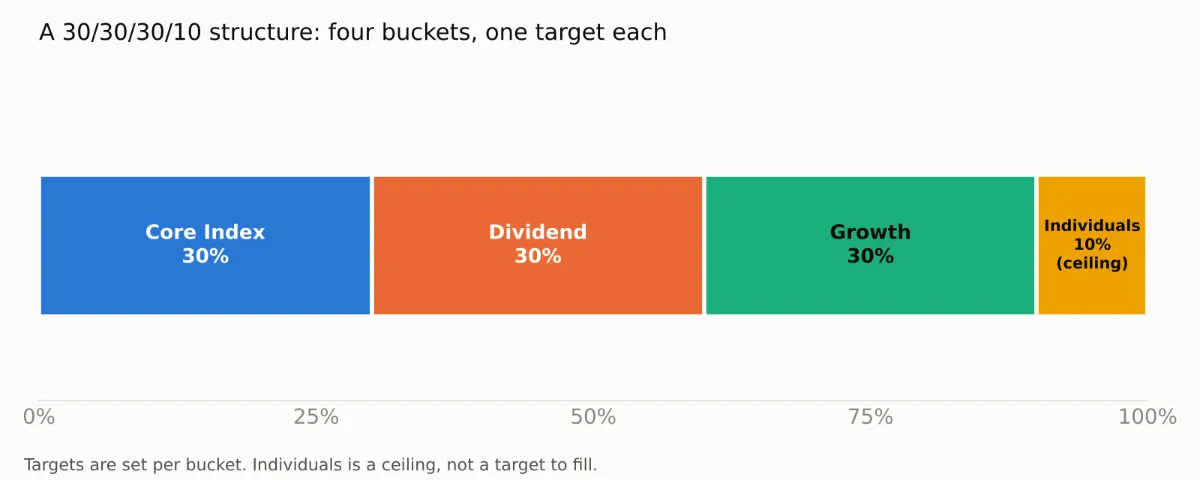
Chart 1: the 30/30/30/10 structure.
Two rules make it work. First, targets are set per bucket, and you rebalance between buckets, not inside them. Second, the Individuals bucket has a hard limit, so a favourite stock cannot take over the portfolio. Everything else, such as which exact funds to use, depends on where you live, which broker you use, and what you can buy.
Five Ages, One Structure
How should this structure change as you get older? There is no official answer, so here is an illustration, built on one idea: the stock part keeps the same 30:30:30:10 proportions, and a calm layer of deposits and/or bonds (Part 3) grows with age. The calm layer is there for the day you need money and the market is down.
AgeCalm layerStocksCore IndexDividendGrowthIndividuals (ceiling)200%100%30%30%30%10%3010%90%27%27%27%9%4020%80%24%24%24%8%5030%70%21%21%21%7%6040%60%18%18%18%6%
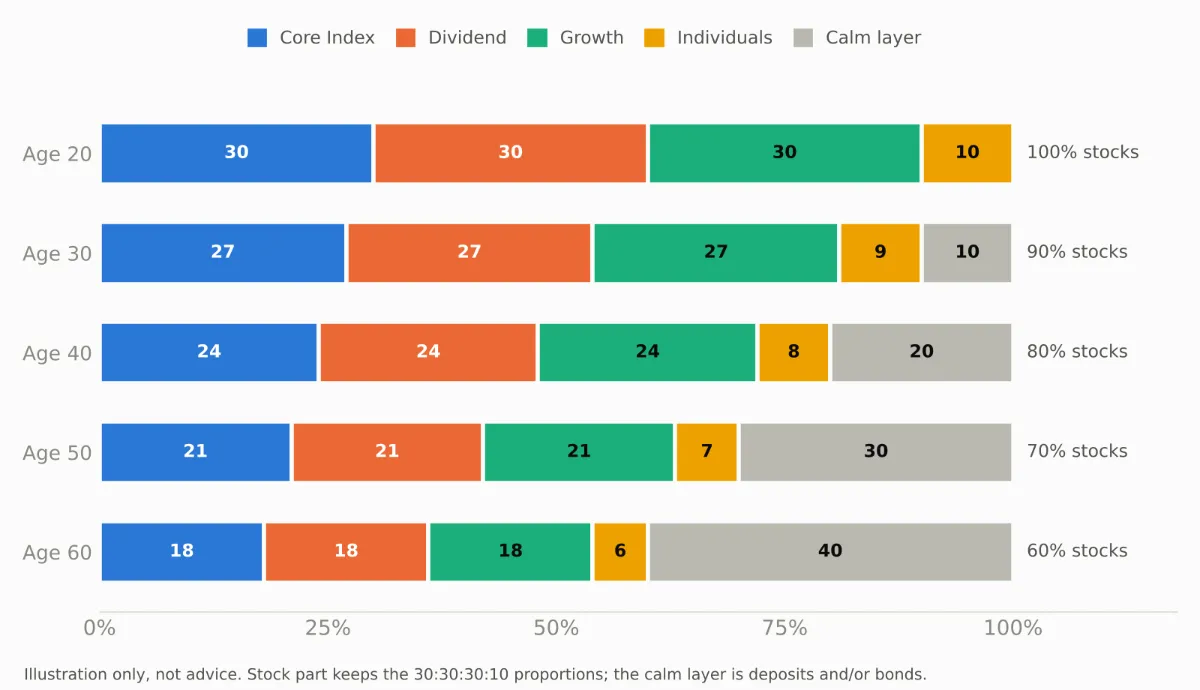
Chart 2: the same four buckets at five ages, with a growing calm layer.
For a reference point, compare the stock share with the Vanguard target date path from earlier: 90% at age 25, 50% at 65, 30% at about 72 [Vanguard]. The illustration here is in the same range, and a little more aggressive early, because it assumes a funded emergency fund outside the portfolio.
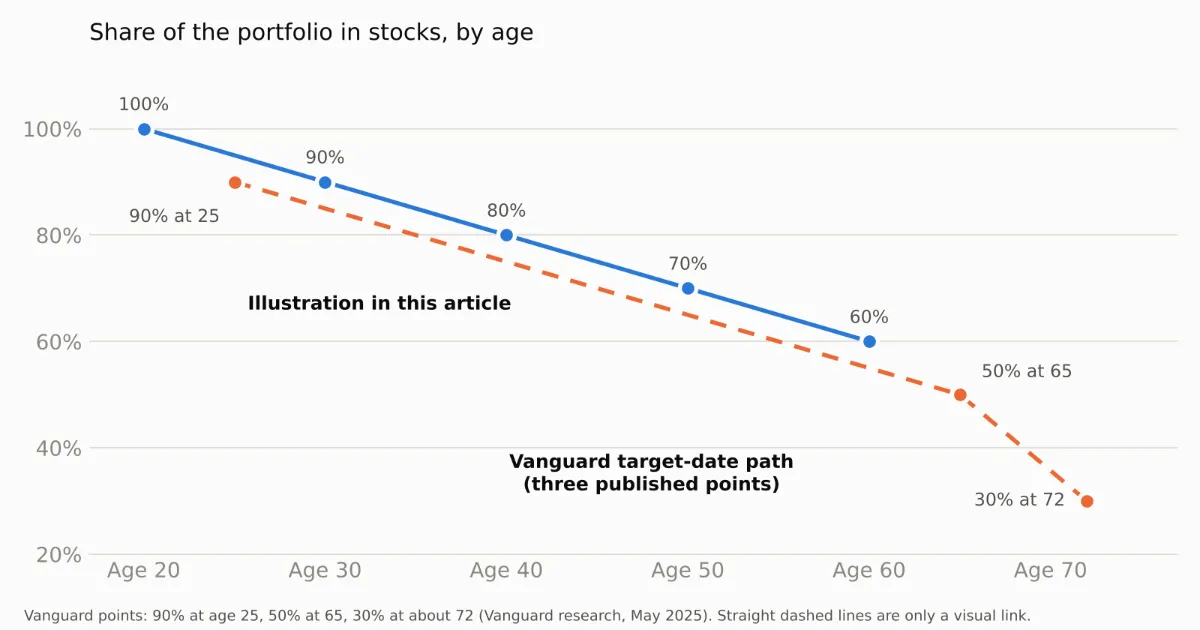
Chart 3: stock share by age, illustration versus three published Vanguard points.
What changes with each age, besides the numbers? Here is one way to think about it:
1) Age 20: contributions do the work. Balances are small, so your savings rate matters far more than the exact mix. Rebalance with new money. Use the Individuals bucket to learn, with small amounts, and treat it as tuition.
2) Age 30: the first calm layer. Goals often become more concrete, such as a home or a family. Money you may need in the next few years belongs in the calm layer. Rebalance on a fixed schedule, for example once or twice a year.
3) Age 40: drift starts to matter. Balances are larger, so a good year in one bucket moves real money. Chart 4 shows what this looks like. Keep the schedule, and decide the rules before the market tests you.
4) Age 50: the calm layer becomes important. A bad market now has less time to recover before you need the money. You may want a lower ceiling for Individuals, and you should look at pension and tax rules in your country. Compare your mix with a target date fund, as a reality check.
5) Age 60: planning the withdrawal. The question changes from "how do I grow this?" to "how do I live on this?" The "to" or "through" choice from the SEC bulletin becomes real. Many people also review whether the calm layer matches the currency they will spend. This stage is a good moment for a licensed adviser, because the details of your country matter a lot.
Here is the rebalancing example for age 40. Suppose the year goes like this (hypothetical returns, not a forecast): Core Index +12%, Dividend +6%, Growth +25%, Individuals -20%, calm layer +4%. The whole portfolio gains about 9.5%, but the mix drifts. Growth, which started at 24%, is now about 27.4%, and Individuals falls from 8% to about 5.8% (my calculation).
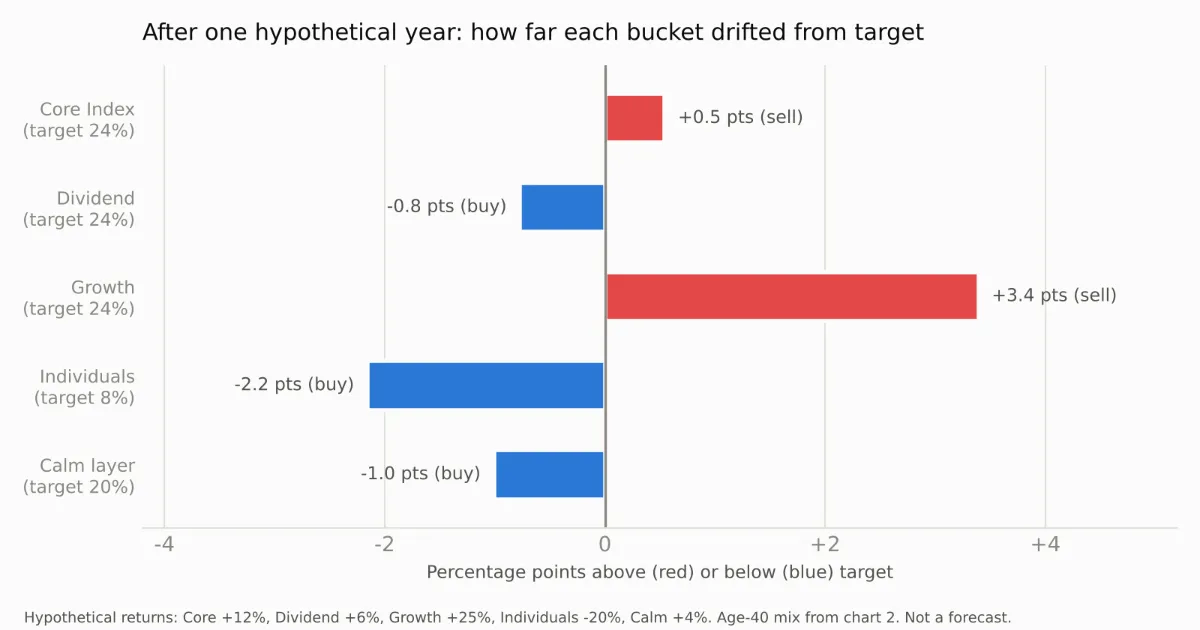
Chart 4: drift after one hypothetical year, and which buckets to sell or buy to return to target.
The fix is to sell about 3.4 points of Growth and 0.5 of Core Index, and add 2.2 to Individuals, 1.0 to the calm layer, and 0.8 to Dividend. In practice, with a monthly contribution you might fix most of this by putting new money into the buckets that are below target. For the Individuals bucket, remember it is a ceiling, so topping it up is optional.
Your First-Portfolio Worksheet
Take a piece of paper and answer these. Do not look for the "right" answers; look for honest ones.
1) What is the money for, and when do I need it?
2) Do I have an emergency fund that I can reach in a week?
3) How big a loss could I accept, in percent, without selling? Think of the 2022 example: a 17% fall in a balanced portfolio.
4) Which buckets do I want, and what is the target percentage for each?
5) How will I invest: a lump sum, regular amounts, or both, and through which broker? (Part 2 has the broker, ISIN, and fee checks.)
6) When will I rebalance, and what will I do when the news is scary? Write it down now.
Portfolio as an Example
Here is a worked example, so you can see how the structure meets reality. It describes Sam, an imaginary investor. Sam is not a real person, and this is not a recommendation. Amounts and balances are left out, because only the percentages and the structure matter.
Sam's starting point. Sam's horizon is 25 years or more, and Sam accepts a high level of risk: a drop of 30% to 40% in the stock part would hurt, but would not make Sam sell. (Remember the two words from earlier: ability and willingness.) The emergency fund is funded, and Sam keeps deposits in the local currency as a buffer, so there is never a need to sell funds at the bottom. Sam earns in a local currency and invests in US dollars, which shapes several choices below.
The four buckets. Sam uses the 30/30/30/10 structure from above:
BucketTargetExample fundsNotesCore Index30%Vanguard FTSE All-World UCITS ETF Acc (ISIN IE00BK5BQT80); Invesco S&P 500 UCITS ETF Acc (ISIN IE00B3YCGJ38)The All-World fund has a 0.14% ongoing charge and holds shares directly (physical). The Invesco fund has a 0.05% ongoing charge and uses swaps (synthetic), so it carries the counterparty risk from Part 2.Dividend30%Vanguard FTSE All-World High Dividend Yield UCITS ETF Acc (ISIN IE00BK5BR626)0.29% ongoing charge, physical, 2,364 holdings. It is accumulating: it does not pay out dividends, it reinvests them inside the fund.Growth30%A US-listed growth ETFIn this example it can only be bought through an international broker that offers US markets.Individualsup to 10%A few single stocksA ceiling, with no more than 2% to 3% of the portfolio in any one stock.
These funds are examples that make the idea concrete. They are not recommendations, and you may not be able to buy them in your country. Fund data comes from the providers' factsheets dated between July and August 2026: Vanguard All-World, Vanguard High Dividend Yield, Invesco S&P 500. Check the latest factsheets before you use any number.
Notice that the table names each fund by its ISIN. Tickers repeat across exchanges and currencies, as we saw in Part 2, so the ISIN is the safest way to be sure which fund you mean.
Why UCITS funds for the core: tax. Imagine that Sam's broker statements show about 30% withheld at source on dividends from US-listed funds. That is the default US rate for foreign investors when no treaty gives a discount. Take a hypothetical fund that yields 3%: withholding then costs about 3% x 30% = 0.9% a year (my calculation, for illustration). Irish-domiciled UCITS funds commonly pay a lower US withholding rate of 15% inside the fund, because of the US-Ireland tax treaty, according to an ETF issuer's guide for non-US investors [State Street]. For the same hypothetical 3% yield, that is about 0.45% a year. This is why Sam puts the Dividend bucket, where the dividend tax hurts most, into a UCITS fund. Your country's treaty with the US, your own tax rules, and your broker's reporting may give a different answer, so treat this as a method, not as a result. Some swap-based funds may also avoid part of the withholding, but that depends on US tax rules that have changed before, so Sam treats it as a possible bonus and not as a certainty.
Why two brokers: fees. Sam's income arrives in the local currency at a local bank, and a local broker charges a small flat fee per trade, so it is the cheap, regular route for funds listed in London. An international broker is the only place to buy US-listed funds, but sending money to it by bank wire has a fixed cost each time. The rule that follows: spend the scarce, expensive route only on what cannot be bought anywhere else. Here that is only the Growth bucket, so the Core and Dividend buckets, 60% of the target allocation, can be fed monthly through the cheap route. When you compare brokers, check four costs: the fee per trade, the currency conversion cost, the cost of moving money in and out, and any yearly or inactivity fees. Part 2 explains how to read a broker's price list.
How Sam rebalances. The rules are few and boring:
1) Rebalance at bucket level, never inside a bucket. Within the Core bucket, the All-World fund stays at no less than half of it, so that international exposure never silently drops to zero.
2) Monthly rule: when the salary arrives, buy the most underweight bucket through its cheap-route fund. One fund per contribution means one trading fee.
3) Occasional rule: when Growth drifts below 30%, send a batch of money to the international broker, instead of sending small amounts many times.
4) The Individuals bucket is a ceiling. Sitting below 10% is fine.
5) Contributions beat precision. At a normal savings rate, the money added each month matters far more than the exact percentages.
What to copy, and what not to copy. The structure travels well: a broad core, a clear job for each bucket, a ceiling for fun money, one rule for new money, and rebalancing at one level. The details do not. Sam's funds, brokers, and tax logic come from Sam's situation: no tax discount on US dividends, income in a local currency, and expensive wires. Yours will be different. Build from your own constraints, in the order of this article: base, questions, mix, tools, rules.
Decide for Yourself
You now have a way to build a portfolio: a base of safe money, three honest questions, a mix, tools that fit your country, a rule for adding money, and a rule for rebalancing. You also have four charts, five age examples, and one worked example portfolio, all of which are illustrations. None of them knows your income, your goals, your family, or your fears.
Start small if you need to, and write your plan down while you are calm. Read the official sources for your country. Come back to the plan once or twice a year, not every day.
In Part 5, we get practical: how to read a fund factsheet line by line, and how to build a simple yearly routine so the portfolio runs without drama.
Educational content only, not financial advice. The age examples and the example portfolio are illustrations of how one structure can work. They are not recommendations for you. Rules, taxes, and available products differ by country, so check what applies to you. Figures from official sources were checked in October 2026.
References
1) An essential guide to building an emergency fund, Consumer Financial Protection Bureau (US)
2) Asset Allocation, Investor.gov (US SEC)
3) Target Date Funds, US SEC Investor Bulletin, 25 March 2025
4) Choice of equity landing points, Vanguard research, May 2025
5) Global Investment Returns Yearbook 2026 (public summary), UBS Investment Bank
6) Big Picture: Return of the 60/40, Morgan Stanley Investment Management, Q2 2024
7) Cost averaging: Invest now or temporarily hold your cash?, Vanguard
8) What Is Market Timing?, FINRA, 10 June 2025
9) Investor Bulletin: Behavioral Patterns of U.S. Investors, US SEC, 16 June 2014
10) Morningstar: Investors miss out on 15% of fund total returns, WealthManagement.com (reporting Morningstar's "Mind the Gap" 2025; secondary source)
11) Bad timing does not cost investors fund returns, Financial Analysts Journal, CFA Institute
12) Red Flags of Investment Fraud Checklist, Investor.gov (US SEC)
13) EU financial regulators warn consumers on the risks of crypto-assets, ESMA / EBA / EIOPA, 17 March 2022
14) Armenia IOPS Country Profile, OECD, September 2021
15) Considerations for non-US investors: US-domiciled ETFs vs. Irish-domiciled UCITS ETFs, State Street Investment Management, 2 June 2026 (published by an ETF issuer)
16) Vanguard FTSE All-World UCITS ETF (USD) Accumulating, factsheet, Vanguard, 28 July 2026
17) Vanguard FTSE All-World High Dividend Yield UCITS ETF (USD) Accumulating, factsheet, Vanguard, 31 August 2026
18) Invesco S&P 500 UCITS ETF Acc, factsheet, Invesco, 31 August 2026